
I Sleep Less Now, But Feel More Rested

I Sleep Less Now, But Feel More Rested
At 44, I was never a morning person.
I didn't set out to "fix" my sleep. I wasn't tracking it obsessively or trying different hacks.
But something unexpected happened when my rhythm changed.
The strangest part wasn't sleeping better. It was realizing I no longer thought about sleep at all.
The Old Story: "I Need 8 Hours or Something's Wrong"
For a while, I carried this quiet anxiety about sleep.
YouTube videos. Sleep experts. Well-meaning advice—all saying the same thing: 7-8 hours minimum, or you'll die younger.
I'd wake naturally after 6 hours, feeling fine. But instead of trusting that, I'd lie there questioning myself.
Should I force myself back to sleep?
The pressure to get "perfect sleep" was doing more damage than the lack of sleep itself.
What Actually Changed (Without Trying)
I didn't change my sleep habits directly. What changed were the inputs:
- Earlier mornings - My body started waking at 4am naturally
- CryoForge breathwork - 3 rounds, first thing
- Cold exposure - Ice showers, 2-5 minutes
- Daily movement - Walking, yoga, breath-hold exercises
- Less stimulation at night - Quieter evenings, no screens late
Important: I didn't do these things for sleep. Sleep changed as a side effect.
When my days aligned, my nights reorganized themselves.
This didn't happen overnight. These changes happened gradually over several months as I built the CryoForge practice. And for a while, I still carried the anxiety about "not getting enough sleep."
When Forcing Sleep Felt Wrong
There were moments when I tried to force more sleep because the YouTube experts said I needed it.
I'd wake naturally after 6 hours, feel clear, then lie there trying to convince my body to go back under.
It didn't.
Not because something was wrong—but because it was already finished.
That resistance was information.
The problem wasn't the number of hours. It was the doubt that made me override a signal that was already working.
The Moment Doubt Started to Lift
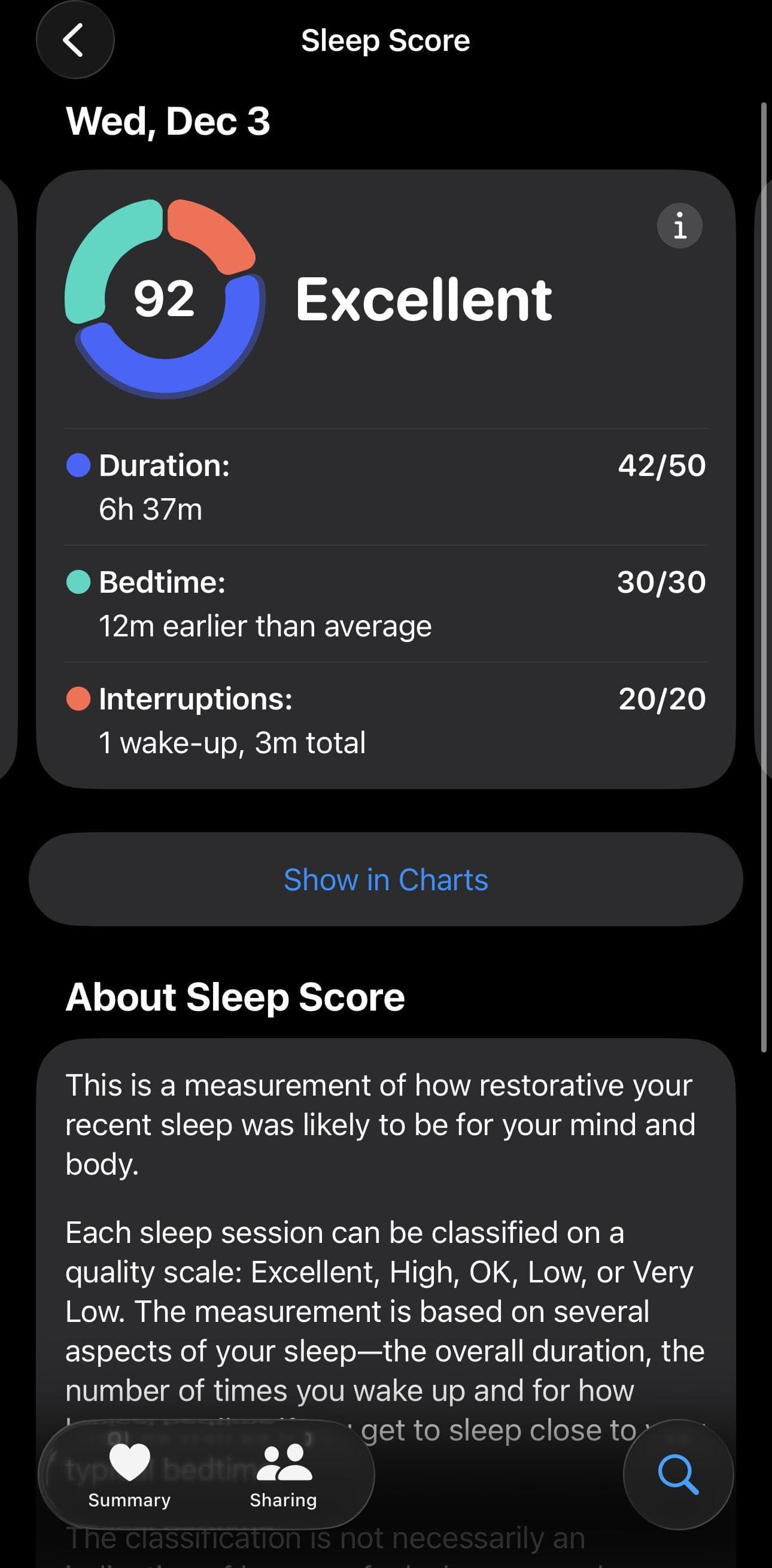
Sleep score of 92 despite only 6 hours—this is what prompted me to investigate
One morning I woke up and glanced at my watch.
Sleep score: 92.
That stopped me. I looked closer at the details.
I had only slept 6 hours.
That didn't make sense. According to everything I'd been told, 6 hours should have left me wrecked. The score should have been much lower.
But I felt fine. More than fine—I felt rested.
More deep sleep than usual. Fewer wake-ups. Better recovery metrics than I'd seen in months.
This was the trigger. Something wasn't adding up—and I needed to understand why.
I started investigating. Not because something was wrong, but because something was clearly right that I didn't understand yet.
I was sleeping fewer hours—but my sleep quality went up.
That was the moment I realized the story I'd been telling myself was wrong.
I wasn't under-sleeping. I was over-worrying.
What I Started Looking Into
Once I saw that contradiction—high score, low hours—I started digging.
I went back through weeks of Apple Watch data. Not just sleep scores, but the patterns underneath:
- When did deep sleep happen? (Almost always in the first 3-4 hours)
- How much time was I actually awake during the night? (Almost none)
- What was my resting heart rate during sleep? (Consistently low, 50s-60s)
- How did this compare to when I was sleeping 7-8 hours but felt worse?
That's when the pattern became clear.
It wasn't about the hours. It was about what my body was doing during those hours.
Why Fewer Hours Can Feel Better
Here's what I've learned, without the biohacking jargon:
1. Sleep Depth Matters More Than Duration
A regulated nervous system enters deep sleep faster. Less fragmented sleep. Less negotiating with the night.
My body stopped fighting and went straight to work.
2. Nervous System Regulation = Sleep Efficiency
When the nervous system is calm during the day:
- Less nighttime cortisol
- Faster entry into deep sleep
- Fewer wake events
You're not "short-sleeping"—you're sleeping efficiently.
3. After 40 (At Age 44), Timing Matters More Than Volume
Early-night sleep aligns better with circadian hormone release. Melatonin production follows natural dark-light cycles, and sleep-dependent hormones are most active in the first sleep cycles.
Late sleep often follows stimulation, not fatigue.
This isn't about forcing bedtime. It's about noticing when sleep feels restorative versus when it feels borrowed.
What the Numbers Reflected (Not What I Chased)
I'm sharing this not as a target, but as context.
Apple Watch data showing high sleep efficiency and intact sleep stages—markers of nervous system regulation
My latest Apple Watch sleep data:
- Total sleep: 6h 37m
- Awake time: 3 minutes (extremely consolidated)
- Deep sleep: 1 hour
- REM sleep: 1h 35m
- Heart rate during sleep: 52-72 bpm (calm, parasympathetic)
- Sleep quality ranking: Top 25% for my age group
Comparison: Average sleep patterns for men in their 40s (based on sleep research and Apple Watch population data):
- Total sleep: 7-8 hours (often needed to compensate for poor quality)
- Awake time: 15-30 minutes (fragmented sleep, multiple wake events)
- Deep sleep: 30-45 minutes (lower percentage of total sleep)
- REM sleep: 1h-1h 30m (similar, but takes longer to reach)
- Heart rate during sleep: 60-80+ bpm (elevated, sympathetic activation)
- Sleep efficiency: Often below 85% (more time in bed ≠ more rest)
The difference isn't just numbers—it's what those numbers represent.
When the nervous system is dysregulated, the body needs more time in bed to get the same recovery. More hours, but less depth. More fragmentation. More negotiating with sleep.
When it's regulated, sleep becomes efficient. Less time needed, but more effective.
What stood out wasn't the score—it was the contradiction:
Less time → More efficiency → Better recovery
The data didn't tell me what to do. It removed the fear that I was doing something wrong.
When Bedtime Shifts, Sleep Compresses
A recent night reinforced an important pattern I've been noticing: my body adjusts sleep duration based on recovery demand and timing, not a fixed number of hours.
I went to bed later than usual—around 11 PM instead of 10 PM—and woke naturally around 4 AM. Just over five hours of total sleep.
At first glance, that might seem unhealthy. But looking at the underlying data, something different emerged.
A later bedtime, shorter sleep—but deep and REM stages remained intact, and vitals stayed stable
That night's sleep data (Jan 13–14, 2026):
| Metric | Value |
|---|---|
| Total time asleep | 5 hr 5 min |
| Awake time | 10 min (my daughter woke me—not a natural wake) |
| Deep sleep | 1 hr 5 min (~21%) |
| REM sleep | 1 hr 38 min (~32%) |
| Core sleep | 2 hr 22 min (~47%) |
| Heart rate | 54–73 BPM (stable, no late-night spikes) |
| Respiratory rate | 11.5–16.5 breaths/min |
| Wrist temperature | −0.26°F from baseline |
| Sleep score | 63 (OK) |
The sleep score was lower—but driven entirely by short duration, not fragmentation or poor quality. Deep and REM sleep completed. Physiological signals remained stable. The brief mid-sleep wake was external (my daughter), and my final morning waking occurred naturally.
What this pattern suggests:
When I go to bed earlier (closer to 10 PM), sleep consolidates tightly—sometimes with zero detected awakenings. When I go to bed later, total sleep time shortens, but the restorative stages are preserved.
Instead of breaking down, sleep appears to compress and prioritize what matters most.
This supports the idea that my body isn't responding to the clock alone—it's responding to actual recovery needs. Early waking in this context doesn't feel like stress or insomnia. It feels like completion.
Why 4 AM? It's the Sun, Not the Clock
I started wondering: is waking at 4 AM just random? My personal quirk? Or is something else going on?
Turns out, it's neither random nor arbitrary. 4 AM is a biologically meaningful window—and my nervous system is now regulated enough to follow it.
What's Actually Happening Around 4 AM
1. Cortisol begins its natural rise
Between 3:30–5:00 AM, the body initiates what's called the Cortisol Awakening Response (CAR):
- Cortisol rises gradually
- Blood pressure increases
- Core body temperature climbs
- The brain shifts toward alertness
In stressed systems, this spike is abrupt—causing anxious, jarring early waking. In regulated systems, it's smooth—resulting in calm, natural waking.
My data (stable heart rate, below-baseline temperature, preserved REM) suggests the second pattern.
2. Core body temperature hits its lowest point
Your lowest body temperature typically occurs around 2–4 AM. Once it starts rising:
- Sleep pressure drops
- The brain transitions out of sleep
- Waking becomes more likely—if recovery is complete
My slightly below-baseline nighttime temperature fits this pattern.
3. The sun matters—even before you see it
This surprised me. Even before sunrise, ambient light changes:
- Blue wavelengths increase
- Melanopsin-containing cells in the retina detect it
- The brain receives "day is coming" signals
You don't need to see the sun directly. Your nervous system anticipates it.
This is why people in natural light cycles often wake 60–120 minutes before sunrise—consistently, without alarms.
Why This Wasn't Happening Before
When the nervous system is dysregulated:
- Cortisol timing is erratic
- Sleep pressure stays high
- The body clings to sleep longer—or wakes early with stress
As regulation improves:
- Hormones re-synchronize
- Sleep completes earlier
- Waking aligns with circadian biology
I didn't train myself to wake at 4 AM. My body stopped fighting its own clock.
Why Bedtime Changes Duration But Not Wake Time
This connects to the pattern I noticed earlier:
- Earlier bedtime (~10 PM) → longer, more consolidated sleep
- Later bedtime (~11 PM) → compressed sleep, but still completed
The circadian wake signal arrives around the same time regardless. When I go to bed later, sleep shrinks—but the body prioritizes deep and REM first, so the essential work still gets done.
The wake signal still comes at ~4 AM.
One Important Note
This doesn't mean everyone should wake at 4 AM. The exact time varies by latitude, season, light exposure, and individual chronotype.
But pre-sunrise waking is extremely common in regulated systems. Historically, this was normal.
What's not normal is needing alarms, sleeping through rising cortisol, or waking groggy after "enough hours."
When recovery is complete, the body wakes with the sun—not the clock.
What the Data Actually Gave Me
I wasn't expecting those numbers.
But seeing them changed something.
Not belief. Not certainty. Just permission to trust what I was already feeling.
For months, I'd been waking up feeling rested but questioning whether 5-6 hours was "enough." The data didn't tell me what to do—it removed the fear that I was doing something wrong.
That's what CryoForge gave me: a nervous system calm enough that my body could do in 6 hours what used to take 8.
I didn't gain time by sleeping less. I gained time by needing less recovery.
The Shift: Wanting to Wake Up
The strangest realization came on weekends.
Everyone else in my house wanted to sleep in.
I didn't.
My body wanted to get up—not out of discipline, but because it felt good to be awake.
That's when I realized: When people want to sleep through life, it's often because life feels exhausting—not because they don't value it.
When rest is deep, waking up feels like returning to life—not starting a battle.
Being Alive vs. Just Recovering
What surprised me most wasn't sleeping fewer hours—it was what opened up because of it.
When your body spends less time negotiating with sleep, it has more energy for being awake.
I wasn't dragging myself out of bed or recovering from the night. I woke clear, calm, and ready to move.
That extra time wasn't about productivity. It was quiet time. Morning light. Movement. Stillness. Time that felt lived, not rushed.
This is what a regulated nervous system gives you: less time spent recovering, more time spent living.
Important: I'm Not Advocating for Less Sleep
Let me be clear:
I'm not promoting less sleep. I'm promoting better sleep—and trusting your body when it tells you it's had enough.
Sleep as much as you need. Just don't let someone else's number convince you that your body is wrong.
This isn't an argument for sleeping less—it's an observation about what happens when sleep becomes deeper and more efficient.
When the body is regulated and well-rested, it often needs less time to get the same amount of recovery.
What This Taught Me
Three realizations:
1. Sleep reflects safety A calm nervous system doesn't need long shutdowns.
2. Waking without an alarm is a sign of regulation, not discipline When the body feels safe during the day, it doesn't cling to the night.
3. Quality comes from alignment, not effort Sleep is an outcome, not a target.
Sleep as a Signal, Not a Goal
I don't chase sleep anymore. I listen to it.
When it changes, I know something upstream has shifted.
Sleep improved when I stopped trying to fix it—and started living in a way my nervous system could trust.
The goal isn't fewer hours—it's deeper rest.
Related Posts:
- Belly Fat Isn't About Age: It's About Unresolved Stress
- The CryoForge Reset: How I Rebuilt My Body at 44
- CryoForge Complete Protocol Guide
- Days 1-10: Building the Foundation
Disclaimer: This is my personal experience and documentation for educational purposes only. Sleep needs vary by individual. If you have sleep disorders, chronic fatigue, or health concerns, consult a healthcare professional. I'm not a doctor. Do your own research and listen to your body.