
The Ancient Reflex That Calms Your Body Automatically — All You Need Is a Bowl of Ice Water
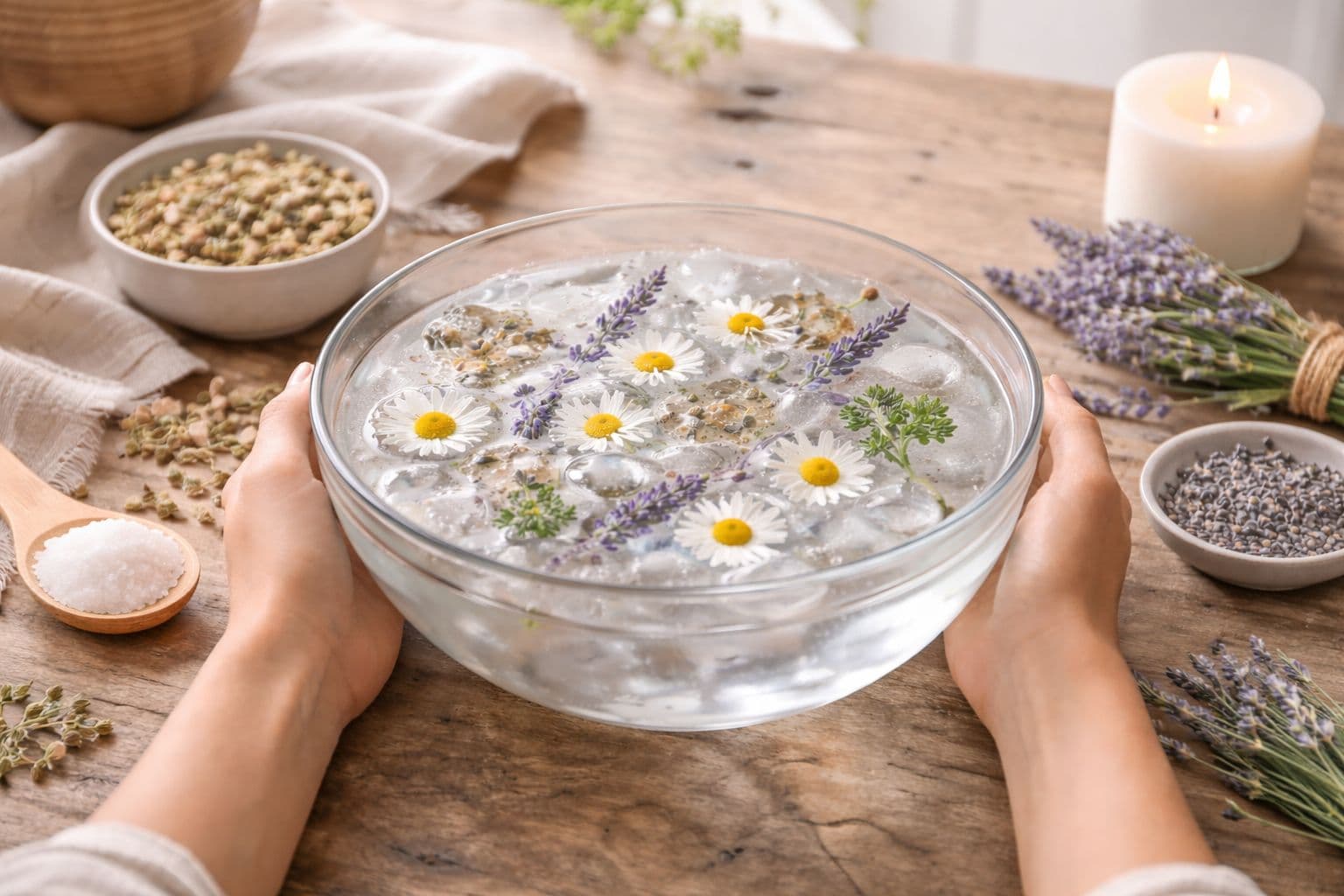
What if the simplest entry point to nervous system training was a bowl of ice water and 20 seconds?
Not an ice bath. Not a complex breathwork protocol. Not months of cold shower conditioning.
Just a bowl, some ice, a cup of lavender and chamomile tea brewed into the water—and your face.
I started thinking about this after something I noticed during my CryoForge ice shower experiments. Something so simple I almost dismissed it. But when I looked at the data, I couldn't ignore it anymore.
During my ice showers, my heart rate didn't spike the way I expected during cold exposure.
It dropped. To around 60 bpm.
And when I stepped out, it rose gently to 70-80 bpm—not from stress, but from the body calmly rewarming itself.
That pattern showed up over and over. Different sessions. Different times of day. Same response.
That's not toughness. That's not adaptation from months of cold showers.
That's a reflex—an ancient one—finally getting permission to do its job.
What I Thought Was Happening vs. What Was Actually Happening
For weeks, I'd been doing the full CryoForge protocol: breathwork, ice shower, movement, heat exposure. It worked. My sleep improved. My stress response felt smoother. My body recovered faster.
But I couldn't tell what was doing the heavy lifting.
When I looked into why my heart rate was dropping instead of spiking during cold exposure, I found the answer: the mammalian dive reflex. It activates when cold water hits your face—especially around the nose and eyes. And during an ice shower, that's exactly what happens. Cold water streams over your face with every breath.
My ice shower data showed:
- Average HR: 73 bpm during the cold
- Peak HR: ~98 bpm (brief)
- Recovery: back to baseline in under 2 minutes
The cold shock response—the gasp, the HR spike, the fight-or-flight activation—was barely there. Instead, something else had taken over.
That realization led me to a question: if the face is the trigger, could you isolate just that part and still get the reflex? That's where the ice bowl idea came from—strip away the full shower, the shivering, the endurance piece, and focus only on what actually activates the dive reflex.
The Reflex That Lives Below Thought
Here's what I learned from digging into the physiology:
When cold water hits your face—especially around the nose and eyes—and you hold your breath, it triggers the mammalian dive reflex through the trigeminal nerve (Panneton, 2013; Gooden, 1994). This reflex is hardwired into your brainstem. It doesn't ask permission. It doesn't require belief.
It just activates.
Within seconds:
- Your heart rate slows (bradycardia)
- Blood vessels in your limbs constrict
- Blood is shunted to your brain and vital organs
- Your body enters a state of calm, controlled protection (Gooden, 1994)
This isn't meditation. This isn't visualization. This is your biology responding to two ancient signals—cold and breath-holding—that tell it: protect what matters most.
The dive reflex evolved to help mammals survive submersion in cold water—conserving oxygen, protecting the brain, staying calm under pressure. It's the same reflex freedivers use to sit underwater with remarkably low heart rates (Panneton, 2013).
And it still works. Today. In your bathroom.
But here's the key insight from my experiments:
You only need two things to trigger this reflex: cold water on your face and holding your breath.
That's it. Cold hits the trigeminal nerve around your nose and eyes (Gooden, 1994). Breath-holding signals the brainstem that oxygen conservation matters. Together, they activate the dive reflex—every time.
No breathwork training required. No special technique. No months of cold shower conditioning.
Just cold water, your face, and a held breath.
The reflex doesn't care how experienced you are. It doesn't need you to be calm first. It makes you calm. That's the difference between this and every other nervous system practice—you don't have to earn it. You just trigger it.
The Simplest Possible Protocol
After weeks of full cold showers, breathwork rounds, and complex protocols, I wanted to find the absolute minimum viable version.
Could someone access this nervous system training with just a bowl of ice water?
Here's the simplest version that still works:
The Ice Bowl Ritual (10-30 seconds)
Setup:
-
Bowl large enough for your face
-
Brew a cup of lavender and chamomile tea, pour it in the bowl, add cold water and ice cubes
(not required—plain ice water works fine. But if you're doing this daily, the scent and ritual of brewing tea turns it into something you actually look forward to instead of dread. Pro tip: brew a batch, freeze it into ice cubes, and you've got ready-to-go herbal ice whenever you want it)
-
Towel nearby
-
Standing or sitting—both work. Just make sure you're stable and not in a situation where losing balance could be dangerous
Protocol:
- Sit comfortably
- Take a calm inhale and hold your breath
- Place your face in the water (nose and cheeks submerged)
- Hold for 10-20 seconds (beginners) or 20-30 seconds (experienced)
- Lift head, exhale, breathe normally
- Rest 30-60 seconds
- Repeat 1-3 rounds
That's it.
No extreme breath holds. No pushing limits. No heroics.
The goal isn't endurance. The goal is activation + recovery.
You're teaching your nervous system:
- Here's what calm feels like under stress
- Here's what protection feels like
- Here's how to switch states cleanly
Short, calm, repeatable exposure beats long and extreme every time for nervous system training.
Why Lavender and Chamomile Tea?
You could just use plain ice water. The dive reflex doesn't care what's in the bowl—it cares about temperature.
But brewing a cup of lavender and chamomile tea and adding it to the ice water does something worth noting.
Lavender has been shown to reduce anxiety and promote calm through its effect on the limbic system. When your face is in the water, you're breathing it in—through your nose, across your skin. It's not aromatherapy hype. Linalool, the primary compound in lavender, has documented anxiolytic effects—it works on the same GABA pathways that anti-anxiety medications target.
Chamomile is one of the oldest medicinal herbs, used for centuries as a mild sedative and skin soother. Topically, it has anti-inflammatory properties. In the water, it softens the experience slightly—less harsh on the skin, especially around the eyes.
Together, they turn the ice bowl from a clinical exercise into something that feels like a ritual.
And that matters. Because rituals get repeated. Clinical exercises get abandoned.
Here's what the tea adds:
- Calming scent while your face is submerged—your breathing between rounds carries lavender and chamomile into your system
- Skin-soothing properties that reduce irritation from repeated cold exposure
- Intentionality — the act of brewing tea, pouring it in, adding ice, sitting down—this is preparation. It signals to your nervous system that something deliberate is about to happen
- A gentler entry point — for someone who's never put their face in ice water, the herbal scent makes the experience less intimidating and more inviting
The dive reflex still does the heavy lifting. The tea just makes you want to come back tomorrow.
When to Do This: Morning vs. Night
This is one of those rare practices where both options work—but they do different things.
Morning Ice Bowl (Priming the Day)
Picture this: face in the bowl before coffee, before screens, before the day starts pulling at you.
What it does:
- Triggers a norepinephrine release — cold exposure on the face increases norepinephrine, the same neurotransmitter behind focus, attention, and alertness. It's a clean, natural wake-up signal without caffeine jitter
- Sets your vagal tone for the day — activating the dive reflex early means your parasympathetic system is already warmed up (Jungmann et al., 2018). Stress that hits you at 10 a.m. meets a nervous system that's already practiced calm once today
- Establishes a regulated baseline — instead of waking up reactive and staying reactive, you start from a place of controlled activation. The day's chaos lands on a steadier foundation
- Pairs naturally with a morning routine — it takes 20 seconds. Before brushing your teeth. Before your first sip of water. Before anything else demands your attention
Morning is about priming. You're telling your nervous system: "We start the day by choosing calm under pressure."
Night Ice Bowl (Resetting from the Day)
Some nights, the day doesn't let go easily. Mind still running. Body still wired. That low-grade hum of unfinished stress buzzing through your chest.
What it does:
- Shifts from sympathetic to parasympathetic dominance — the dive reflex directly activates the vagus nerve, pulling you out of fight-or-flight and into rest-and-digest (Jungmann et al., 2018). This is the exact state transition that many people struggle with at bedtime
- Interrupts the stress-to-sleep pipeline — instead of carrying the day's cortisol into bed, you give the nervous system a clear signal: "The threat is over. We're safe now." That's hard to do with willpower alone, but the dive reflex doesn't need willpower
- May improve sleep onset — by lowering heart rate and activating parasympathetic pathways right before bed, you're essentially giving your body a head start on the physiological shift that happens during sleep onset
- Clears residual tension — that "wired but tired" feeling is your sympathetic nervous system refusing to stand down. Cold on the face is a direct, physical override. Not a suggestion. Not a breathing exercise you have to remember. A reflex
Night is about resetting. You're telling your nervous system: "The day is done. We can let go now."
Why Not Both?
Honestly? Both works.
Morning and night serve different purposes:
| Morning | Night | |
|---|---|---|
| Purpose | Prime for the day | Reset from the day |
| Primary effect | Alertness + regulated baseline | Calm + parasympathetic shift |
| Feels like | Waking up on purpose | Letting the day go |
| Best for | Focus, stress resilience | Sleep onset, unwinding |
| Pairs with | Coffee, sunlight, movement | Stretching, quiet, sleep |
If you only pick one, pick the one that matches your biggest struggle:
- Mornings feel chaotic and reactive? → Morning bowl
- Nights feel wired and restless? → Night bowl
- Both? → Both
The nervous system doesn't get tired of this. It gets better at it. Each session—morning or night—adds another rep of clean state switching.
What Happens When You Do This Repeatedly
This isn't a one-time trick. It's training.
With repeated face-in-cold exposure over days and weeks, your nervous system adapts:
1. Stronger vagal tone The parasympathetic (rest-and-digest) response becomes faster and more reliable. Heart rate slows more easily under stress. Recovery after stress improves (Jungmann et al., 2018).
2. Reduced threat perception The nervous system learns: "Cold on the face ≠ danger." Chemoreceptors become less reactive. Panic responses weaken. This is conditioning, not willpower.
3. Improved autonomic flexibility You're not staying calm all the time—you're learning to enter calm quickly when needed, then return to normal function smoothly. That flexibility is associated with cardiovascular health, stress resilience, and better sleep quality (Laborde et al., 2017).
4. Cleaner breathing patterns Even without formal breathwork, breathing becomes slower and less erratic under stress. CO₂ tolerance improves indirectly.
This is what I saw in my own data after weeks of CryoForge experiments—heart rate dropping to ~60 bpm during cold exposure and recovering rapidly afterward. Not because of toughness. Because the body learned when to activate protection and when to release it.
The Progression Ladder (If You Want to Go Deeper)
The ice bowl ritual is a perfect starting point—but it's also part of a larger progression:
Level 1: Face in ice water (10-30 seconds, 1-3 rounds) → Activates dive reflex with minimal risk → Accessible, repeatable, safe
Level 2: Face in ice water + breathwork (CryoForge breathwork first, then face bowl) → Primes the dive reflex to win immediately → Amplifies the response
Level 3: Cold shower (full body exposure, 2-5 minutes) → Broader stress tolerance training → Metabolic adaptation
Level 4: Combined practice (Breathwork → Cold → Movement) → Integration under load → Full nervous system efficiency
You don't have to do all of it. Start where you are.
The face bowl is enough to begin teaching your nervous system what calm under stress actually feels like.
Why This Works When Other Things Don't
Most nervous system training relies on conscious effort:
- Meditation (awareness)
- Breathing exercises (voluntary control)
- Mindfulness (mental discipline)
Those are valuable. But they require practice, focus, and belief.
The dive reflex is different.
It's a brainstem-level, automatic, physiological response. You don't believe it into working. You don't need to "get good at it." You trigger it, and it responds.
That's why this transfers so well to real life:
- Stress doesn't wait for you to remember your breathing pattern
- Anxiety doesn't care if you've meditated that day
- Pressure doesn't pause while you find your calm
But if your nervous system has been trained—through repeated dive reflex activation—to shift into protection mode quickly and cleanly, it just does it.
Automatically. Without thinking. When it matters.
The Mystical Part That's Actually Just Biology
There's something almost spiritual about putting your face in ice water and feeling your heart slow down.
Not because it's magic—but because it's recognition.
Your body isn't learning something new. It's remembering something older than language, older than culture, older than modern stress.
This reflex evolved millions of years ago to protect air-breathing mammals from cold water submersion (Panneton, 2013). It's the same mechanism that lets seals dive for 20 minutes. The same reflex that keeps freedivers calm at depth.
And it's still inside you. Right now. Waiting.
When you activate it intentionally, there's this quiet sense of: "Oh. My body already knows how to do this."
That feeling—of calm, trust, clarity—isn't placebo.
It's remembering.
What Surprised Me
I went into this thinking cold exposure was about toughness. About building resilience through suffering.
But experimenting with the ice bowl changed that assumption:
Cold isn't the point. Calm is.
The cold is just the signal that tells your nervous system: "This is the moment to practice protection without panic."
You're not building toughness. You're training precision.
And precision—clean state switching between stress and calm—is what actually matters for long-term health.
Not how long you can suffer. Not how much you can endure.
How quickly you can return to baseline after stress.
That's resilience.
The 40-Day Ice Bowl Challenge
If this resonates, here's a simple challenge: do the ice bowl ritual once a day for 40 days.
That's it. No progression plan. No tracking spreadsheets. No increasing the time or adding complexity.
Just one session a day—morning or night—for 40 days.
Why 40 days?
It's long enough for the nervous system to genuinely adapt. Not just a novelty response—actual conditioning. By day 10-14, you'll likely notice the cold feels different. Less shocking, more familiar. By day 30, the shift happens outside the bowl—stress lands differently, recovery feels faster, sleep comes easier.
40 days is also short enough to commit to without it feeling like a lifestyle overhaul. It's 20 seconds a day. Less time than brushing your teeth.
What to notice along the way:
- How the cold feels on day 1 vs. day 14 vs. day 30
- Whether your resting state starts to feel different (calmer baseline, less background tension)
- How you respond to stress on days you've done the bowl vs. days you haven't
- Sleep quality—especially if you do the night version
You don't need to journal. You don't need to measure your heart rate. Just show up, do the ritual, and pay attention.
40 days of teaching your nervous system what calm under pressure feels like.
That's a foundation worth building.
The 20-Second Invitation
If you feel:
- Tired even when you sleep enough
- Wired but unable to fully relax
- On edge for no clear reason
- Like stress just… never fully turns off
You don't need a complex protocol. You don't need an ice bath. You don't need months of practice.
You need a bowl of ice water, a cup of lavender chamomile tea, and 20 seconds.
Your dive reflex isn't broken. It's just untrained.
And training it is simpler than you think.
Brew the tea. Pour it in the bowl. Add cold water and ice. Sit down. Inhale. Face in. Hold your breath. Lift head. Exhale.
That's the whole ritual.
Your body will do the rest—because it already knows how.
It always has.
Have you ever noticed your body responding to cold in a way that felt automatic—like something deeper than thought took over? What did that feel like?
Safety Notes & Disclaimer
Disclaimer: This is my personal experience and documentation for educational purposes only. Cold exposure and breath-holding can be dangerous if done incorrectly or without proper preparation. If you have cardiovascular conditions, respiratory issues, or other health concerns, consult a healthcare professional before attempting any cold exposure or breathwork practices. I'm not a doctor. Do your own research and listen to your body.
Important Safety Guidelines:
- Never practice this while driving or in situations where losing balance could cause harm
- Start with shorter exposures (10 seconds) and build gradually
- Stop immediately if you feel dizzy, nauseous, lightheaded, or experience chest pain
- Cold exposure can be particularly risky for people with heart conditions, Raynaud's disease, or cold urticaria
- Pregnant women should avoid extreme cold exposure and prolonged breath-holding
- Make sure you're stable during face immersion—standing or sitting both work, just stay balanced
- Keep exposure times short (10-30 seconds maximum for beginners)
- Breathe normally—do not force extreme breath holds during cold exposure
Signs to stop immediately:
- Dizziness or lightheadedness
- Tingling or numbness (beyond normal cold sensation)
- Panic or air hunger
- Pressure in the head
- Visual narrowing or tunnel vision
- Chest pain or irregular heartbeat
This is reflex training, not endurance testing. The goal is calm, controlled exposure—not pushing limits.
References
Gooden, B.A. (1994). Mechanism of the human diving response. Integrative Physiological and Behavioral Science, 29(1), 6-16. https://doi.org/10.1007/BF02691277
Jungmann, M., Vencatachellum, S., Van Ryckeghem, D., & Vögele, C. (2018). Effects of Cold Stimulation on Cardiac-Vagal Activation in Healthy Participants: Randomized Controlled Trial. JMIR Formative Research, 2(2), e10257. https://doi.org/10.2196/10257
Laborde, S., Mosley, E., & Thayer, J.F. (2017). Heart Rate Variability and Cardiac Vagal Tone in Psychophysiological Research. Frontiers in Psychology, 8, 213. https://doi.org/10.3389/fpsyg.2017.00213
Panneton, W.M. (2013). The mammalian diving response: an enigmatic reflex to preserve life? Physiology (Bethesda), 28(5), 284-297. https://doi.org/10.1152/physiol.00020.2013
Related Posts: